





I remember sitting in my car after discharge, hands on the steering wheel, feeling oddly flat.
Not devastated. Not hopeful. Just… unimpressed.
I had done what they said. I showed up. I talked in group. I even believed parts of it. And yet, months later, I was back in the same cycle. So I told myself what a lot of people say:
Treatment doesn’t work for me.
If that’s where you are, I’m not here to argue with you. I’m here to sit next to you in that frustration and say something direct:
It’s possible the problem wasn’t that treatment doesn’t work.
It’s possible the problem is that it didn’t work the way you needed it to.
And that’s a different conversation.
Within the first few weeks of going back into a more structured, live-in setting through a residential treatment program, I realized something I didn’t understand the first time:
Participation is not the same as surrender.
Attendance is not the same as honesty.
Completion is not the same as change.
You Can Do Everything “Right” and Still Hold Back
You can memorize the language of recovery.
You can say, “I need to set boundaries.”
You can say, “I’m working on coping skills.”
You can say, “I take responsibility.”
And still keep the real story locked up.
A lot of us do.
Not because we’re manipulative. Not because we’re incapable. But because telling the whole truth feels like stepping off a cliff.
The first time I went through treatment, I gave them the edited version of my life. The acceptable trauma. The socially palatable regrets. I left out the parts that made me feel disgusting or weak.
Guess which parts kept running my life afterward?
Treatment isn’t mind-reading. It can only work with what you bring into the room.
That’s not blame. That’s physics.
Sometimes the Structure Wasn’t Enough
Some programs are short. Some are loosely structured. Some rely heavily on individual motivation outside of programming hours.
For some people, that works.
For others—especially if home life is chaotic or triggers are everywhere—less structure means more opportunity to slip back into old habits.
A round-the-clock environment can change that equation. When you’re in a space where the expectations are clear, the schedule is consistent, and the distractions are removed, your brain gets a break from constant survival mode.
It’s hard to learn new behaviors when you’re still swimming in the same water that taught you the old ones.
For some people, that level of immersion makes the difference between surviving treatment and actually absorbing it.
You Might Have Left Too Soon
This is uncomfortable, but it’s real.
Sometimes we leave as soon as we feel slightly better.
Sleep improves. Appetite comes back. The panic lowers. And we think, Okay, I’m good.
But stabilization isn’t the same thing as rewiring.
Addiction—and the mental health struggles that often come with it—develop over years. Expecting permanent change in a few weeks can set you up for disappointment.
It’s like going to physical therapy for a torn ligament. If you stop when the pain decreases but before strength returns, the injury doesn’t heal fully. It just waits.
If you’ve relapsed after treatment, it doesn’t mean nothing worked. It may mean the healing wasn’t finished.
You Might Have Been Doing It for Someone Else
Court order.
Family pressure.
Partner ultimatum.
External motivation can get you in the door. It rarely sustains deep internal change.
If you were there to keep someone else from leaving, or to avoid consequences, you might have complied without committing.
That doesn’t make you hopeless. It makes you honest.
Real momentum tends to build when the internal dialogue shifts from:
“I have to be here.”
to
“I don’t want to live like this anymore.”
That shift is quiet. It’s personal. And sometimes it doesn’t happen until after the first attempt.
You Expected to Feel Fixed
No one says this out loud, but many of us walk into treatment with a secret hope:
“Please fix me.”
We want to leave different. Lighter. Immune.
But treatment isn’t a personality transplant. It’s a foundation. It gives you tools, awareness, and a break from chaos. What happens next depends on how those tools get used.
Cravings don’t disappear permanently. Emotional triggers don’t vanish. Life doesn’t suddenly stop being stressful.
When those things show up after discharge, it can feel like proof that nothing worked.
But discomfort after treatment doesn’t equal failure. It often means you’re now facing life without your old coping mechanism—and that’s hard before it’s empowering.
The Deeper Work Might Not Have Happened Yet
For many people, substance use is layered over other pain:
- Trauma that was never processed
- Anxiety that predates the addiction
- Depression that feels woven into your identity
- Shame that’s older than the substance itself
If the first experience focused mostly on behavior—stopping use, building routines, avoiding triggers—but didn’t go deeper, you might have walked away sober but still hurting.
Unresolved pain doesn’t disappear just because you removed the substance.
Sometimes a more immersive approach allows enough time and safety to actually unpack what’s underneath the behavior. That’s where lasting shifts often happen.
Skepticism Is Understandable
If you’re reading this with a guarded mindset, that makes sense.
You don’t want another pitch. You don’t want bright promises. You don’t want to be told you just “didn’t try hard enough.”
Here’s the honest truth:
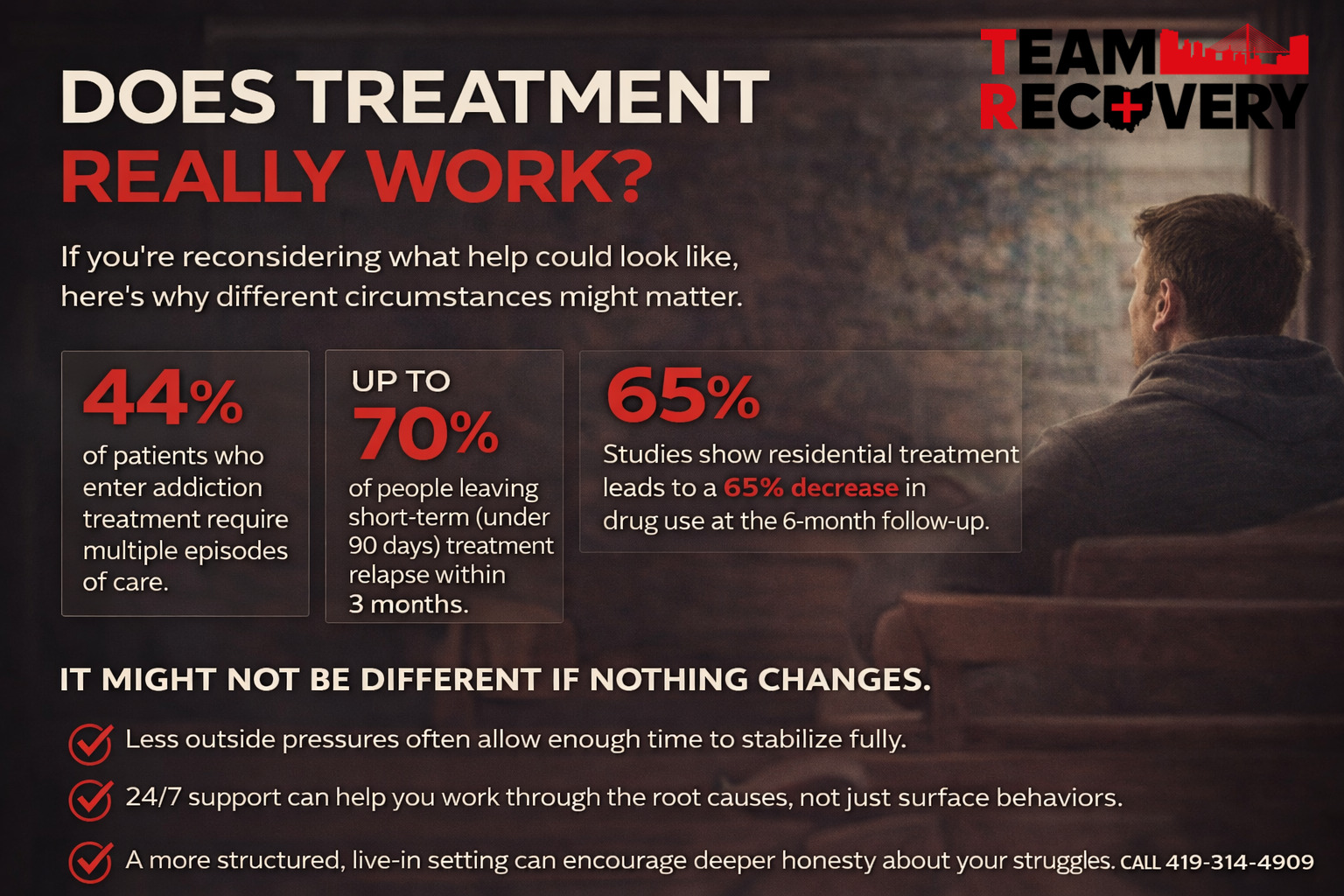
It might not be different if nothing changes.
But if the environment changes, the level of honesty changes, or the depth of work changes—the outcome can change.
People who once swore treatment didn’t work for them often return under different circumstances and have a completely different experience.
Not because they became better people.
But because they became more willing.
If you’re reconsidering what help could look like, you can explore our residential treatment program to see whether a more structured, live-in setting might fit better than what you tried before.
You don’t have to feel convinced.
You just have to feel curious enough to look.
Frequently Asked Questions
What if I’ve already tried treatment more than once?
Multiple attempts don’t mean you’re resistant to recovery. Many people require more than one episode of care. Each attempt can build awareness, even if it doesn’t result in immediate long-term sobriety. The key question isn’t “Why didn’t it work?” It’s “What was missing last time?”
How do I know if I need a more structured setting?
If you’ve struggled to stay sober after returning home, felt overwhelmed by triggers, or found yourself isolating quickly after discharge, you may benefit from more consistent structure and support. A live-in environment can reduce outside pressure long enough to stabilize fully.
Is it normal to feel numb or skeptical about trying again?
Yes. Disappointment can flatten motivation. Skepticism often protects you from getting your hopes up again. That doesn’t mean you don’t care. It just means you don’t want to be hurt twice.
What if I’m afraid I’ll fail again?
That fear is common. Recovery isn’t a pass/fail test—it’s a process. What matters most is whether you’re willing to adjust the approach, not whether you can guarantee the outcome.
Does needing residential care mean I’m worse than other people?
No. Level of care is about fit, not worth. Some people need more time and support away from daily triggers. That’s not a reflection of character—it’s a reflection of what helps you stabilize and heal.
If you’re even thinking about trying again, that’s not weakness. That’s evidence that some part of you still wants something different.
Call 419-314-4909 or visit our residential treatment program services to learn more about our residential treatment program services in Toledo, Ohio.

