





You never thought you’d be here.
Not researching levels of care. Not whispering on the phone in another room. Not watching your child unravel and wondering whether you’re about to make the biggest decision of their life.
When someone first mentions a higher level of support — maybe even a residential treatment program — it can feel like a punch to the chest.
Is it really that bad?
Are we overreacting?
Is this too much?
If you’re asking those questions, you’re not extreme.
You’re a parent trying to protect your child.
Let’s walk through this carefully.
When Crisis Changes the Rules
There’s everyday stress. And then there’s crisis.
Crisis looks like:
- Sudden paranoia or psychosis
- Escalating substance use
- Not sleeping for days
- Talking about self-harm
- Aggression or total withdrawal
- Rapid mood shifts that feel unrecognizable
When those things start happening, the rules change.
Weekly therapy — which might have worked before — may no longer be enough. A 60-minute session can’t stabilize a 24-hour spiral.
This isn’t about failure. It’s about matching support to reality.
When mental health symptoms intensify — especially when substance use and psychiatric symptoms overlap — containment becomes protective, not punitive.
And that’s often what higher levels of care are designed to provide.
Why “Too Extreme” Feels So Heavy
When parents say something feels extreme, what they often mean is:
- “This sounds permanent.”
- “This sounds scary.”
- “What will my child think of me?”
- “Does this mean I’ve lost control?”
Here’s something we want you to hear clearly:
Choosing live-in treatment is not a declaration of defeat.
It’s a decision about safety and stabilization.
If your child’s environment is fueling instability — access to substances, toxic dynamics, constant triggers — staying home can actually prolong the crisis.
Sometimes the most loving move isn’t adding more conversations. It’s changing the setting.
Understanding Levels of Support (Without the Jargon)
Think of mental health care like a spectrum of intensity.
At one end, there’s:
- Weekly therapy
- Medication management appointments
- Outpatient check-ins
In the middle:
- Structured daytime care
- Multi-day weekly treatment
- Several hours of therapy and group work per week
And at the higher end:
- Round-the-clock support
- Daily therapy
- On-site medical and psychiatric oversight
- A fully structured environment
The purpose of higher support isn’t control. It’s stabilization.
When someone can’t regulate sleep, emotions, or safety on their own — a contained, therapeutic environment creates the space for their nervous system to reset.
And once stability is built, care can step down to less intensive levels.
It’s not a life sentence.
It’s a phase of focused healing.
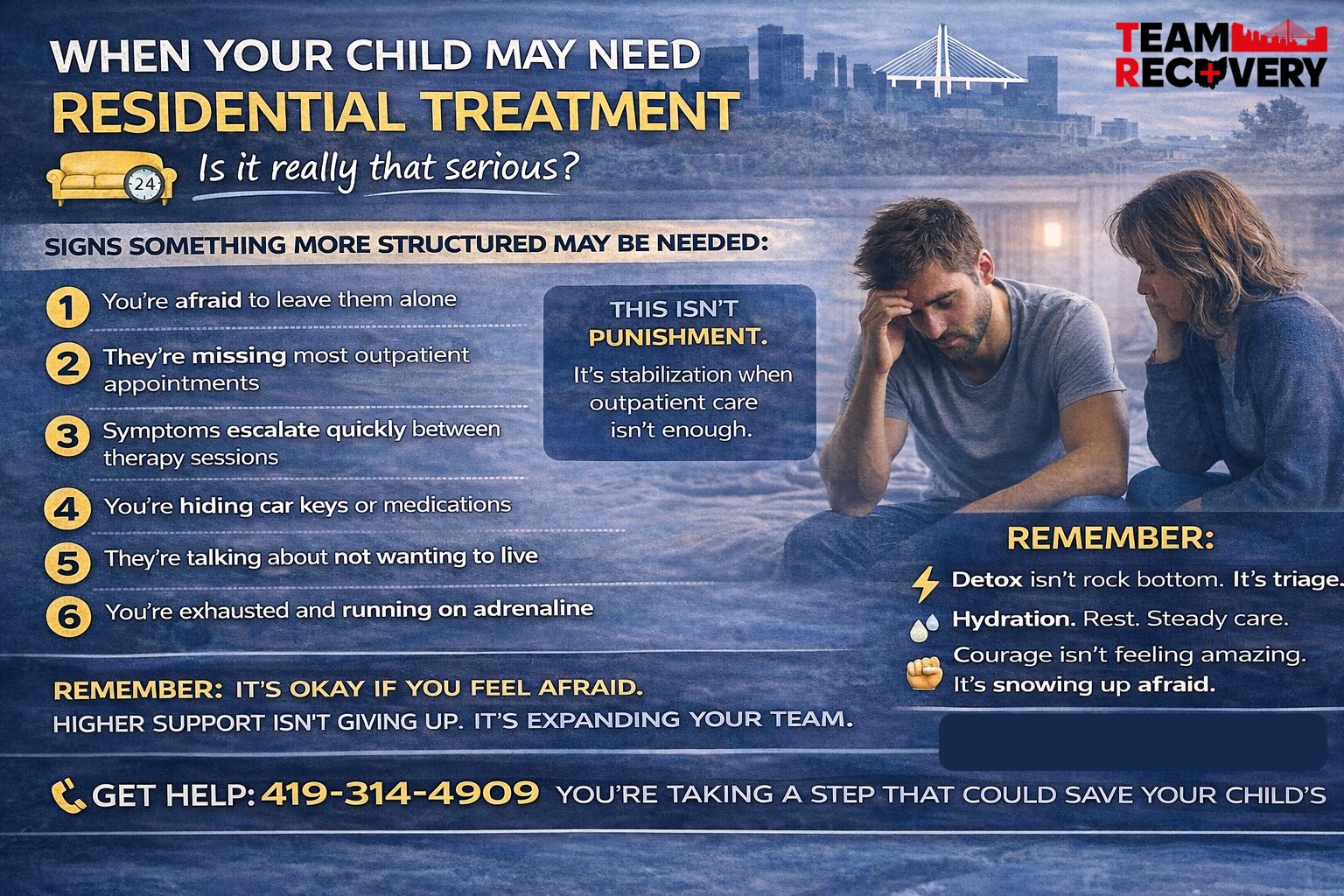
Signs That More Containment Might Be Needed
You don’t need a clinical degree to notice when something has shifted.
Here are some quiet signals parents often describe before moving to a higher level of care:
- You’re afraid to leave them alone.
- You’re checking their breathing at night.
- You’re hiding car keys or medications.
- You feel like your home is in constant emergency mode.
- They’re refusing outpatient appointments.
- Symptoms escalate quickly between therapy sessions.
- You’re emotionally exhausted and running on adrenaline.
When your nervous system is constantly on high alert, that matters.
Parents often minimize their own distress. But your fear is data.
And sometimes that data points toward the need for more consistent, structured support.
What Actually Happens in Round-the-Clock Care?
One of the biggest fears comes from the unknown.
Many parents imagine sterile hallways or cold environments.
In reality, quality residential settings focus on:
- Daily individual therapy
- Group therapy with peers
- Psychiatric evaluation and medication stabilization when appropriate
- Skills training for emotional regulation
- Support around substance use if present
- Predictable routines (sleep, meals, structure)
- A therapeutic community
The structure itself is often what brings relief.
When someone has been spiraling — sleeping at 4 a.m., isolating, using substances to cope — predictability becomes medicine.
And for many young adults, being surrounded by others who understand what they’re going through reduces shame dramatically.
“Will My Child Hate Me?”
This is one of the most painful questions parents carry.
Sometimes, in the beginning, your child might resist.
Crisis clouds perspective. When someone is deep in symptoms, insight is often limited. They may not see the severity of what you’re seeing.
But here’s what we’ve witnessed again and again:
Once stability returns, resentment often softens into understanding.
We hear things like:
“I was mad at first. But I needed it.”
“I didn’t realize how unsafe I was.”
Your role isn’t to be liked in the moment. It’s to protect long-term safety.
And protection sometimes feels uncomfortable.
Is It Really That Serious?
Parents often ask this quietly.
“If we choose something this structured… does that mean it’s severe?”
Severity isn’t a moral judgment. It’s a measure of risk and instability.
If your child is:
- Experiencing psychosis
- Mixing substances with psychiatric medications
- Talking about not wanting to live
- Rapidly deteriorating despite outpatient care
Then yes — it may be serious.
But serious does not mean hopeless.
In fact, early containment can prevent longer-term consequences.
Intervening sooner rather than later often leads to shorter, more effective stays.
Waiting for absolute rock bottom rarely improves outcomes.
You’re Not Giving Up on Them
There’s a myth that choosing higher support means “sending them away.”
We see it differently.
You’re widening the circle of care.
You’re adding professionals, structure, and safety to something that has outgrown what one household can hold.
Love doesn’t decrease when support increases.
It expands.
And families remain involved. Communication continues. Planning for transition happens intentionally.
The goal is not separation.
The goal is stabilization — so they can eventually return home stronger.
FAQ: What Parents Ask Us Most
How long does this level of care usually last?
Length varies based on clinical need. Some individuals stabilize in weeks. Others need more time to address complex mental health and substance concerns. The focus is always on progress, not arbitrary timelines.
Can my child continue school or work?
In many cases, academic or vocational planning is integrated into care. The immediate focus is stabilization, but long-term goals remain part of the treatment plan.
What if they refuse to go?
Resistance is common during crisis. In some situations, safety concerns may require more urgent decisions. In others, collaborative conversations and professional guidance can help increase willingness. You don’t have to navigate that conversation alone.
Will insurance cover this?
Coverage depends on your policy and medical necessity criteria. Our team helps families verify benefits and understand options clearly before any decisions are made.
What happens after they leave?
Higher levels of care are often followed by step-down support like structured daytime care or multi-day weekly treatment. The goal is continuity — not dropping someone from high support to nothing.
Is this only for substance use?
No. Many young adults enter care due to mental health crises — depression, anxiety, trauma, bipolar disorder, psychosis — sometimes with substance use layered in, sometimes not.
What if we wait and try something less intensive first?
Sometimes that’s appropriate. Other times, delaying containment allows symptoms to escalate. An honest clinical assessment can help determine whether starting at a higher level may actually shorten the overall recovery timeline.
You Don’t Have to Carry This Alone
If you’re reading this, you’re probably exhausted.
You love your child. You’ve tried conversations, boundaries, therapy, support.
And now you’re wondering whether it’s time for something more structured.
You don’t have to decide in isolation.
At Team Recovery, we walk families through these crossroads with clarity and steadiness. We help you assess what level of care matches what you’re seeing — not what you wish were true, and not worst-case scenarios.
Sometimes the most loving decision feels like the hardest one.
And sometimes what feels “too much” is actually what creates enough safety for healing to begin.
Call (419) 314 4909 or visit our residential treatment program services to learn more about our residential treatment program services in Toledo, Ohio.

