





I almost signed myself out on day two.
I remember sitting on the edge of that narrow bed, heart racing, convinced I had made a mistake. I told myself I was overreacting. That I wasn’t “that bad.” That I could go home and handle it quietly like I always had.
If you had asked me then, I would’ve told you the detox was dramatic. Overkill. Embarrassing.
Now? I call it the moment everything finally slowed down enough for me to survive.
If you’re a long-term alum reading this — a year, five years, ten — and feeling a little flat lately, a little disconnected from your fire, stay with me. This isn’t a hype piece. It’s a memory.
And maybe a reminder.
Within my first week there, I learned what a medical detox program actually meant for someone like me — not in theory, but in my body.
I Was Angry Because I Was Scared
Let’s tell the truth.
I didn’t complain because the staff was bad.
I complained because I was terrified.
Terrified of the withdrawals.
Terrified of being watched.
Terrified that if I stripped away the substances, there wouldn’t be much left of me.
Long-term sobriety can blur that memory. We romanticize our “decision” to get help. We forget how shaky it actually was.
I wasn’t brave walking in there. I was cornered. And the anger was armor.
If you’re feeling spiritually stale now, it might help to remember: your early recovery wasn’t polished. It was raw.
I Thought I’d Detoxed Before. I Hadn’t.
I had “quit” at home before.
Locked myself in my apartment.
Turned off my phone.
Sweated through the sheets.
Promised I’d never use again.
That wasn’t detox. That was survival mode.
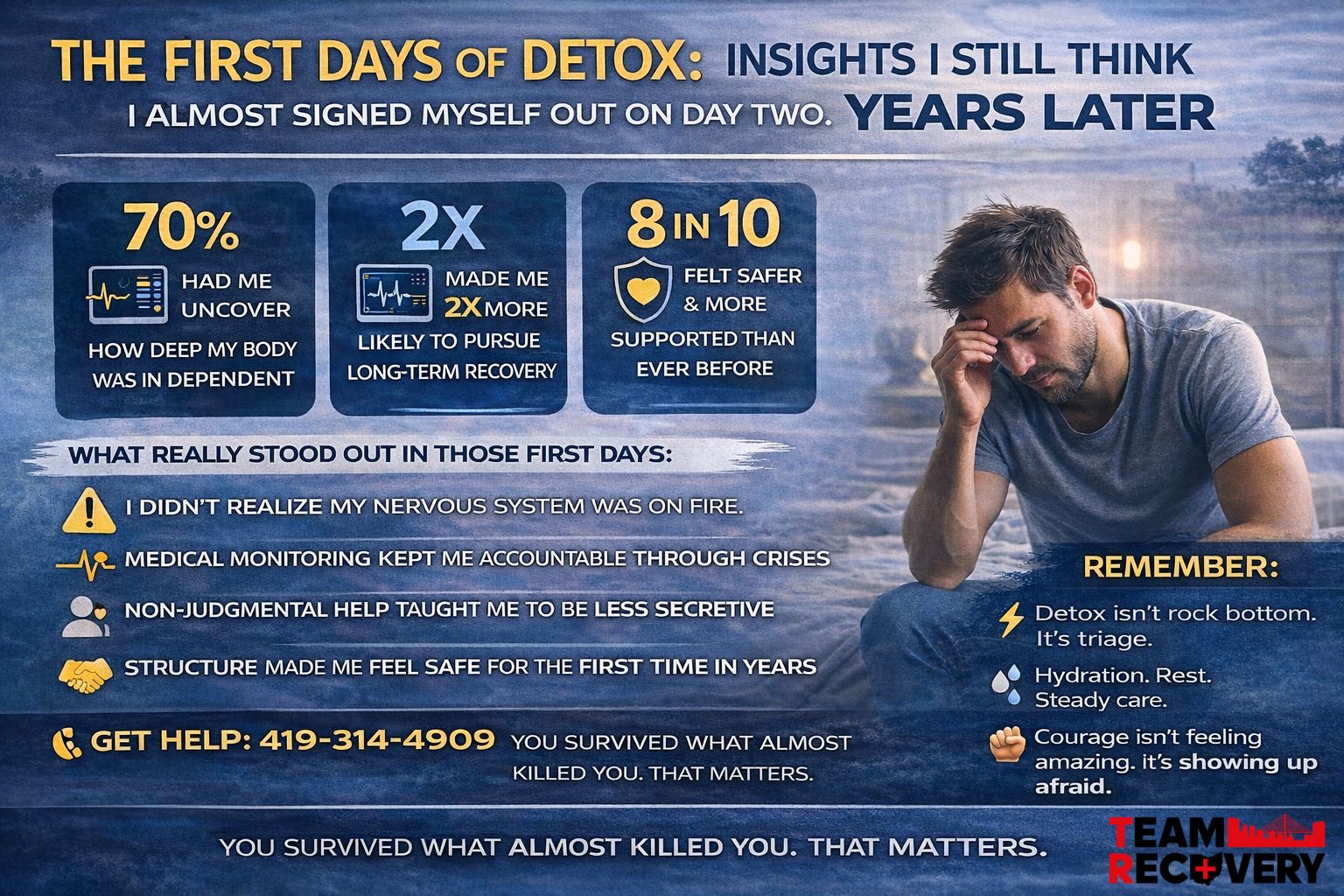
What hit me in those first 48 hours of supervised care was this: my body was in deeper than I admitted. My blood pressure wasn’t stable. My anxiety wasn’t just nerves — it was my nervous system on fire.
There’s something humbling about realizing you were closer to medical risk than you allowed yourself to see.
The staff didn’t panic. They didn’t shame me.
They monitored. Adjusted. Explained. Stayed.
That steadiness is something I still think about years later.
Structure Felt Like Control Being Taken Away
I hated the schedule.
Vitals at specific times.
Medication windows.
Lights out.
I remember thinking, “I’m an adult. I don’t need this.”
What I didn’t realize was that my life before that had zero structure. My days revolved around using, recovering from using, or planning the next time I’d use.
Structure didn’t take my control away.
It gave my brain a break from chaos.
When I talk to other alumni who feel disconnected now, a lot of them aren’t using — they’re just drifting. No structure. No real anchor. Recovery becomes passive.
Those early days taught me something I still lean on: stability first. Meaning second.
The Safety I Didn’t Know I Needed
This is the part that still gets me.
There was a night when my anxiety spiked so hard I thought I was dying. Heart pounding. Chest tight. The old instinct kicked in — “Just use and make it stop.”
Except I couldn’t.
Instead, someone sat with me. Checked my vitals. Spoke calmly. Explained what was happening physiologically. Reminded me my body was recalibrating.
I wasn’t alone in it.
That might sound small. It wasn’t.
For years, every crisis I had was private. Hidden. Fueled by shame.
Being monitored medically wasn’t about control. It was about safety.
That first Medical Detox Program didn’t just clear substances out of my system. It interrupted the cycle of isolation that almost killed me.
Years Later, I See What It Actually Did
At the time, I thought detox was the annoying prerequisite to “real recovery.”
Now I see it was the foundation.
It stabilized my body.
It slowed down my nervous system.
It forced me to pause long enough to consider a different way of living.
If you’re long-term sober and feeling emotionally flat, sometimes it’s not that recovery stopped working. Sometimes it’s that we forgot how unstable we were at the beginning.
We normalize the miracle.
You survived a physiological storm. That matters.
When Sobriety Feels… Ordinary
Here’s the honest part nobody talks about enough.
After a few years, sobriety can feel ordinary.
Bills. Work. Relationships. Stress. Life.
You’re not white-knuckling anymore. But you’re not on fire either. You might find yourself thinking, “Is this it?”
When I feel that way, I remember the hospital-grade blood pressure cuff squeezing my arm. I remember the tremor in my hands. I remember the staff gently but firmly saying, “Your body needs this.”
Detox wasn’t dramatic.
It was necessary.
And remembering that keeps me grounded when recovery feels mundane.
You Don’t Have to Be at Rock Bottom to Need Help Again
Let me say something that would’ve offended early-recovery me:
Needing support again doesn’t erase your time.
It reinforces your commitment to staying alive.
A detox setting isn’t a punishment. It’s stabilization. If someone relapses after years, or their body becomes dependent again, medical oversight is about safety — not shame.
And even for alumni who aren’t using, the deeper lesson still applies: when your system is overwhelmed, structure and support matter.
We’re not meant to white-knuckle anything alone.
FAQ: The Questions I Had (But Didn’t Ask)
Is detox only for people who are “really bad”?
No. It’s for people whose bodies are physically dependent and at risk during withdrawal. The severity isn’t measured by how dramatic your life looks. It’s measured by what’s happening in your body. I looked “functional.” I wasn’t stable.
Can’t you just quit at home?
Sometimes people try. I did. The risk isn’t just discomfort. It can include blood pressure spikes, seizures (depending on the substance), severe anxiety, dehydration, and other complications. Medical supervision reduces those risks and makes the process safer and more manageable.
Does going back mean I failed?
No. Relapse doesn’t erase your growth. It signals that something shifted — stress, trauma, complacency, untreated mental health. Getting medically stabilized again is a responsible move. Not a moral verdict.
Is it just about medication?
Medication can be part of it, yes. But it’s also about monitoring, hydration, sleep regulation, and clinical support. It’s about giving your body a controlled environment to recalibrate instead of forcing it through chaos.
How long does it take?
It varies depending on the substance and individual health factors. For many, it’s several days. For others, longer. What matters isn’t rushing it. It’s doing it safely.
What if I’m embarrassed to come back?
You won’t be the first. Programs that specialize in detox see returning clients. The focus is stabilization — not judgment. Staff understand that recovery is rarely linear.
Shame keeps people sick. Safety keeps people alive.
The Line I Never Thought I’d Say
I used to joke that detox was the worst week of my life.
Now I call it the most important.
It forced a pause I couldn’t create on my own. It gave my body a fighting chance. It showed me that medical care and compassion can coexist.
If you’re an alum who feels stuck, disconnected, or quietly slipping — don’t rewrite your origin story to make it smaller.
You survived something real.
And if you — or someone you love — ever need that level of support again, it’s still there.
Call 419-314-4909 or visit our detox services page to learn more about our Medical Detox Program services in Toledo, Ohio.

