





There’s a moment that doesn’t come with a clear signal.
No alarm. No single event you can point to and say, this is it.
It builds slowly.
Until one day, you realize something that’s hard to say out loud:
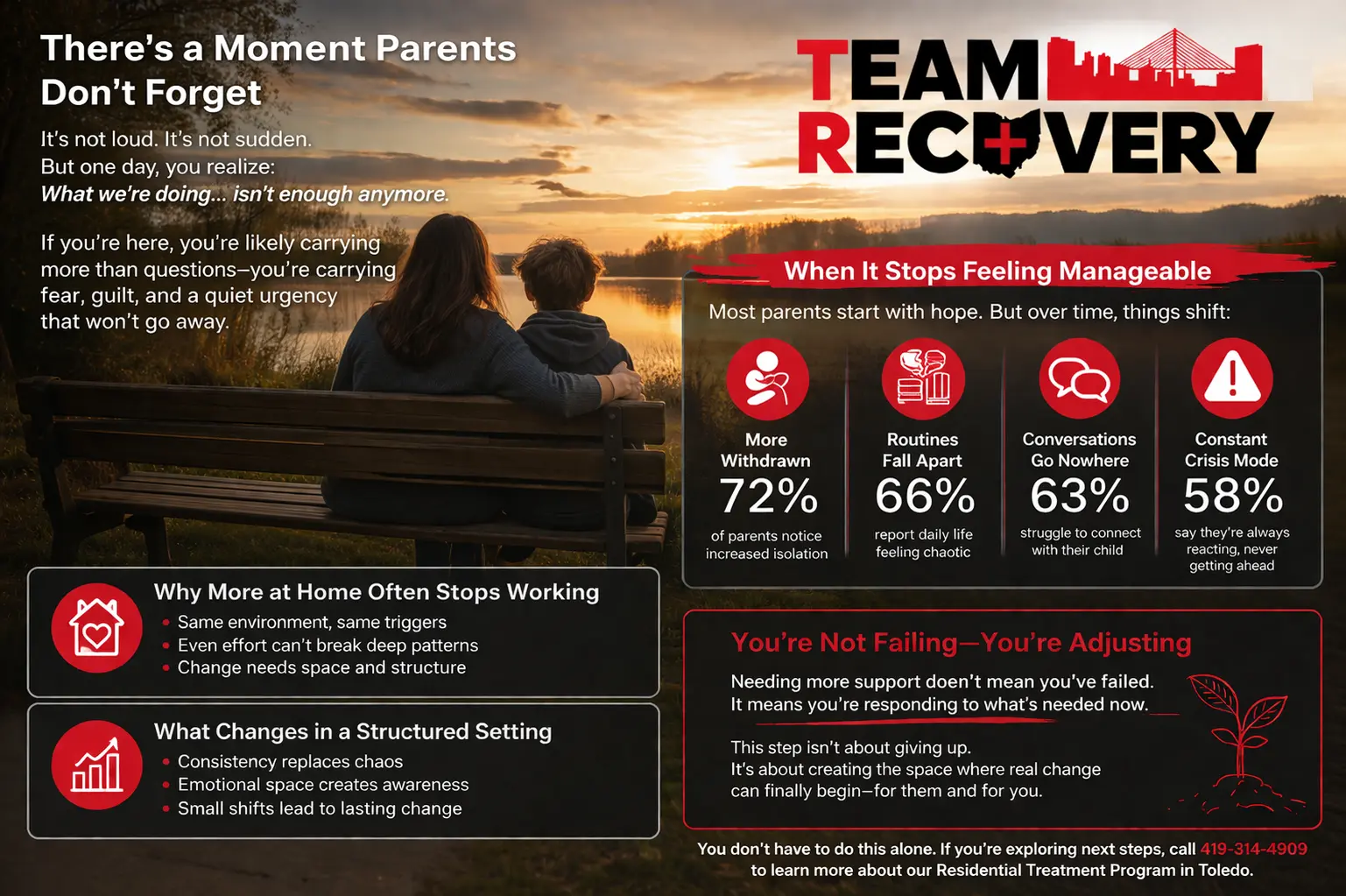
What we’ve been doing… isn’t enough anymore.
And that realization can feel like failure.
If you’re here, looking into something like round-the-clock support, you’re likely carrying more than just questions.
You’re carrying fear.
Guilt.
And a quiet urgency that doesn’t fully go away.
Let’s walk through what this actually looks like—not in theory, but in real life.
The Moment It Stops Feeling Manageable
Most parents don’t start here.
You start with hope that things will shift on their own.
You notice changes:
- They’re more withdrawn
- Conversations feel tense or go nowhere
- Their routines fall apart
- You feel like you’re constantly reacting
At first, you adjust.
You try different approaches.
You give space. Then you lean in.
You set limits. Then you soften them.
And for a while, it feels like maybe something is working.
Until it doesn’t.
There’s a moment where things stop feeling like a phase…
And start feeling like something deeper.
That moment is hard.
But it’s also important.
Because it’s often where real decisions begin.
Why Trying Harder at Home Stops Working
This is one of the most painful parts for parents.
Because your instinct is to do more.
More conversations.
More support.
More attention.
But sometimes, the issue isn’t effort.
It’s capacity.
At home, your child is still:
- In the same environment
- Surrounded by the same triggers
- Operating within the same patterns
Even with your support, those patterns are hard to break.
Not because your child doesn’t care.
But because change requires space—and structure—that’s difficult to create in the middle of everyday life.
This is where many parents start to feel stuck.
Because doing more of the same doesn’t create different results.
What Changes When the Environment Changes
One of the biggest shifts in a live-in setting isn’t what’s added.
It’s what’s removed.
The constant tension.
The unpredictability.
The need to react in the moment.
Things become more consistent.
There’s a rhythm to the day.
That might sound simple.
But consistency is powerful.
Because when things stop constantly shifting, your child’s nervous system has a chance to settle.
And when that happens, something else becomes possible:
Awareness.
Not forced. Not rushed.
Just… possible.
What Your Child Is Actually Going Through Inside
Parents often imagine two extremes.
Either:
- Their child will resist completely
Or:
- They’ll suddenly understand everything and change
But most of the time, it’s neither.
It’s a process.
At first, your child may:
- Push back
- Feel uncomfortable
- Question everything
That’s not failure.
That’s adjustment.
Because for the first time, they’re not able to avoid what’s underneath.
And that can feel overwhelming before it feels helpful.
Over time, something shifts.
They begin to:
- Stay in conversations longer
- Express things more honestly
- Recognize patterns they didn’t see before
These are quiet changes.
But they matter.
The Part That’s Hard for Parents: Your Role Changes
This is where many parents feel a mix of relief and discomfort.
Because you’re no longer managing everything.
But you’re also not as directly involved.
It can feel like stepping back.
But it’s actually stepping into a different role.
Instead of:
- Monitoring
- Fixing
- Trying to control outcomes
You become:
- A steady presence
- A source of support—not pressure
- Part of a system, not the entire system
You may still be involved through:
- Family sessions
- Guided communication
- Support around boundaries and expectations
And sometimes, this is where things become clearer.
Not easier.
But clearer.
The Middle Phase: Where Doubt Shows Up
There’s a point where things don’t feel new anymore.
And this is where many parents start to question their decision.
You might notice:
- Your child sounds frustrated
- Conversations feel tense
- Progress doesn’t look obvious
And your mind goes to:
Is this working?
Did I make the right choice?
Here’s what’s important to understand:
Real progress doesn’t always look calm.
Sometimes it looks like discomfort.
Because your child is engaging with things they’ve avoided for a long time.
That’s not a setback.
That’s movement.
What Progress Actually Looks Like
It’s rarely dramatic.
And that can be confusing.
But progress often shows up in small, steady ways:
- They pause before reacting
- They stay present in difficult moments
- They take small ownership of their choices
These moments don’t feel big.
But they build something important.
Stability.
And stability is what creates lasting change.
The Question That Stays With You
Every parent asks this at some point:
Will they be the same when they come home?
The honest answer is: no.
But that’s not something to fear.
They may:
- Communicate differently
- Set boundaries you’re not used to
- Need space in ways that feel unfamiliar
That can feel like distance at first.
But often, it’s actually growth.
They’re learning how to function without the patterns that kept them stuck.
And you’re learning how to relate to that version of them.
What This Step Really Means
Choosing a higher level of support doesn’t mean things are worse than you thought.
It means you’re responding to what’s actually needed.
It means you’re adapting.
Not giving up.
It’s a shift from trying to manage everything alone…
To allowing something more structured to support both of you.
The Part Many Parents Carry Quietly
There’s often a layer of guilt underneath all of this.
You might wonder:
- Did I miss something earlier?
- Could I have handled things differently?
- Is this my fault in some way?
These thoughts are common.
But they’re also heavy.
And they don’t move things forward.
What matters now isn’t what you could have done differently.
It’s what you’re doing now.
And the fact that you’re here—looking, learning, trying to understand—
That matters.
You’re Not Failing—You’re Adjusting
This is the part that deserves to be said clearly.
Needing more support doesn’t mean you failed.
It means the situation requires more than one person can carry.
And recognizing that is not weakness.
It’s awareness.
You Don’t Have to Do This Alone
You’ve likely been holding more than most people can see.
Trying to balance support, boundaries, fear, and hope—all at once.
That’s a lot.
And you don’t have to keep carrying it alone.
If you’re exploring next steps, Call 419-314-4909 to learn more about our Residential Treatment Program in Toledo.
Frequently Asked Questions
How do I know if my child needs more support than outpatient care?
If progress feels inconsistent, crises keep repeating, or home no longer feels stable, it may be a sign that more structured support is needed.
Will my child feel like they’re being sent away?
At first, they might. But over time, many begin to understand this step as support—not rejection.
How involved can I be during this process?
You’re still part of the process, just in a different way. Many families are included through structured communication and support.
What if my child resists or gets angry?
That’s common. Resistance doesn’t mean the decision is wrong—it often means the situation is difficult.
How long does it take to see change?
It varies. Some changes are immediate, others take time. Progress is usually gradual rather than sudden.
What happens after they return home?
The focus shifts to maintaining stability and continuing support. The goal is not to return to old patterns, but to build something new.

