





You can be successful, respected, dependable — and still privately wonder if your drinking or substance use has started running your life.
That’s the part many high-functioning people struggle to explain. Nothing looks “bad enough” from the outside. The bills are paid. Work still gets done. Maybe your family has concerns, but you’ve learned how to smooth things over quickly. You tell yourself you’ll slow down after this project, this season, this stressful month.
Then another month passes.
A lot of people searching questions about Blue Cross Blue Shield or Aetna coverage aren’t looking for luxury treatment. They’re looking for permission. They want to know whether getting help is even realistic before they allow themselves to seriously consider it.
For many people, exploring live-in addiction treatment options begins quietly — late at night, after another exhausting day of pretending everything is under control.
High-Functioning Addiction Often Hides in Plain Sight
One of the biggest misconceptions about addiction is that it always looks chaotic.
Sometimes it looks polished.
It looks like someone answering Slack messages at midnight with a drink nearby.
It looks like a parent who never misses a soccer game but secretly counts the minutes until they can get home and use.
It looks like someone who keeps receiving praise professionally while feeling emotionally numb almost everywhere else.
As clinicians, we see this often. The people who wait the longest to seek treatment are frequently the people who appear the most “put together.”
Why?
Because external success can become evidence against your own pain.
You start thinking:
- “I’m still functioning.”
- “Other people have it worse.”
- “If I were really struggling, my life would look different.”
- “Maybe I’m just stressed.”
- “Maybe everyone drinks like this.”
But there’s usually a private cost that grows heavier over time.
Sleep gets worse.
Anxiety gets louder.
Relationships become more distant.
You stop feeling fully present in your own life.
And eventually, keeping everything together becomes its own full-time job.
Insurance Questions Usually Carry More Emotion Than People Realize
Most people don’t type “Will BCBS or Aetna cover inpatient addiction treatment?” into Google because they’re casually researching benefits.
Usually, they’re scared.
They’re trying to calculate whether asking for help will create even more problems:
- Financial problems
- Career problems
- Family questions
- Shame
- Exposure
- Loss of control
Sometimes the fear sounds practical:
“What if insurance doesn’t cover enough?”
But underneath that is often another fear:
“What if I finally admit I need help?”
That moment can feel terrifying for high-functioning people because so much of their identity is built around capability. Around being the reliable one. Around holding it together no matter what.
Treatment can feel like an admission that the system you built to survive is no longer working.
Many BCBS and Aetna Plans Do Provide Coverage for Treatment
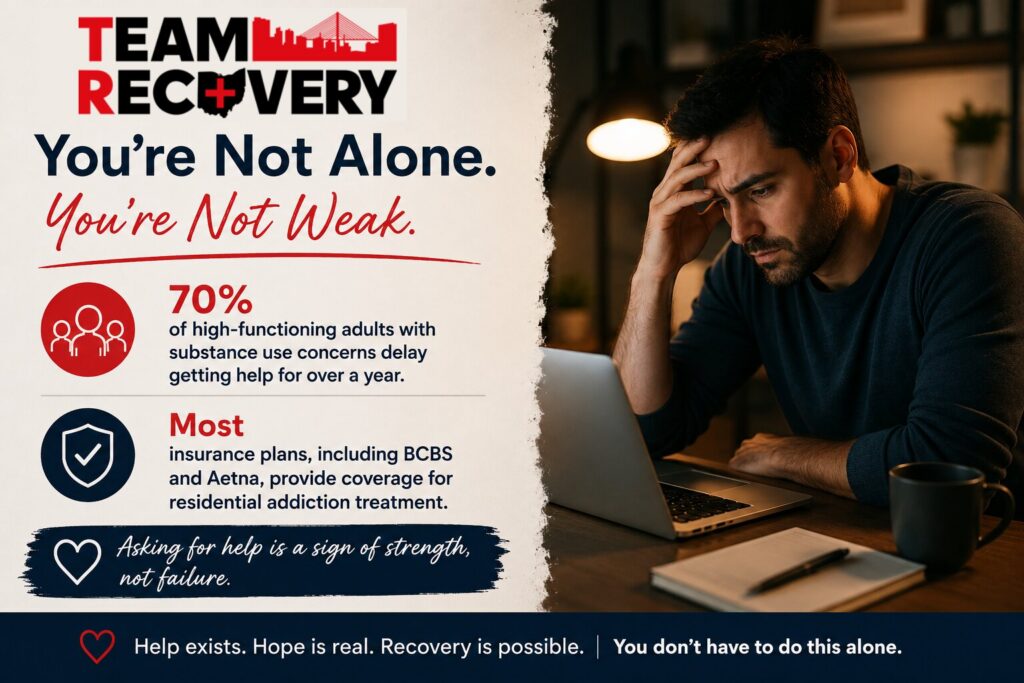
The details depend on your specific insurance plan, deductibles, provider network, authorization requirements, and level of care needed. But many Blue Cross Blue Shield and Aetna plans do help cover substance use treatment, including residential or inpatient care.
That surprises a lot of people.
Many assume treatment is financially impossible before they ever speak with someone.
In reality, insurance coverage for addiction treatment has expanded significantly over the years. Mental health and substance use treatment are now considered essential health benefits under many plans. That does not mean every service is fully covered, but it does mean people are often more eligible for help than they think.
A quality treatment center should be willing to:
- Verify your insurance benefits
- Explain costs clearly
- Help you understand deductibles and coverage
- Discuss payment options honestly
- Walk you through the admissions process without pressure
You should not have to decode insurance language while emotionally overwhelmed.
The Hidden Exhaustion Most People Never See
High-functioning addiction is exhausting because it requires constant management.
You monitor yourself all day long.
You promise yourself tonight will be different.
You negotiate limits.
You hide evidence.
You rehearse conversations.
You calculate how you appear to other people.
Even moments that should feel relaxing stop feeling restful.
One patient once told me:
“I wasn’t enjoying anything anymore. I was just managing myself constantly.”
That’s the part many people don’t recognize as suffering because it becomes normalized slowly.
You adapt to:
- Waking up anxious at 3am
- Feeling emotionally flat
- Needing substances to relax
- Feeling irritable without them
- Losing interest in things you used to care about
- Living with quiet shame
It becomes your baseline.
Like carrying a heavy backpack for so many years that you forget what standing upright feels like.
You Don’t Have to Lose Everything Before Seeking Help
There’s a dangerous myth that people only “deserve” treatment after catastrophic consequences.
That myth keeps countless people trapped.
You do not need:
- A DUI
- A public collapse
- Job loss
- Divorce papers
- A medical emergency
- An overdose scare
Some people seek treatment before things completely unravel. And honestly, that can save enormous pain later.
The goal isn’t to prove your suffering is severe enough. The goal is to ask whether your current life feels sustainable.
A question I sometimes ask patients is:
“If nothing changes, where do you think this goes in five years?”
Most people already know the answer.
They’re just afraid to say it out loud.
Why Residential Treatment Can Feel Safer Than White-Knuckling Alone
Many high-functioning people spend years trying to manage addiction privately.
They cut back temporarily.
Switch substances.
Create rules.
Take breaks.
Hide it better.
Some even convince themselves they don’t need structured help because they’re still “handling life.”
But constant self-management can become its own prison.
Residential treatment gives people something many haven’t felt in years:
Relief from performing.
For the first time in a long time, they can stop monitoring every move and simply focus on healing.
That structure matters.
Especially for people who are emotionally exhausted from trying to maintain normalcy while quietly struggling underneath it.
If you’ve been researching rehab covered by insurance, there’s a good chance part of you already knows you need more support than another promise to yourself can provide.
The Fear of Being Seen Is Real
Many professionals worry about privacy more than treatment itself.
They worry coworkers will find out.
They worry their reputation will change.
They worry they’ll be judged differently forever.
Those fears are real. But they also keep many people isolated much longer than necessary.
In reality, seeking help is often far less visible than people imagine.
And more importantly, the emotional cost of staying silent usually grows over time.
People who finally enter treatment often say some version of:
“I wish I had done this sooner.”
Not because treatment is easy.
Not because recovery is perfect.
But because carrying everything alone had become unbearable.
The First Phone Call Doesn’t Have to Be Perfect
You do not need to know exactly what to say before calling a treatment center.
Most people don’t.
They say things like:
- “I’m not sure if this is bad enough.”
- “I still have my job.”
- “I don’t know if I need inpatient treatment.”
- “I just know I can’t keep doing this.”
That’s enough.
You don’t need a dramatic rock-bottom story to deserve support.
You don’t need certainty.
You don’t need to prove anything.
You only need one honest conversation.
Frequently Asked Questions
Does BCBS usually cover inpatient addiction treatment?
Many Blue Cross Blue Shield plans provide some level of coverage for inpatient or residential addiction treatment. Coverage varies based on your individual plan, deductibles, network status, and medical necessity requirements.
Does Aetna pay for residential rehab?
Many Aetna plans include behavioral health and substance use treatment benefits, including residential care. The amount covered depends on your policy and treatment recommendations.
How do I know if my insurance covers treatment?
The easiest step is allowing a treatment center to verify your benefits. Most admissions teams can explain your coverage, estimated costs, and next steps in a confidential conversation.
Will my employer find out if I use insurance for treatment?
Healthcare privacy laws protect your medical information. While insurance claims are processed through your provider, treatment centers take confidentiality seriously.
What if I’m still functioning normally?
Many people seeking treatment are still working, parenting, or maintaining responsibilities. Functioning externally does not mean you aren’t struggling internally.
Is residential treatment only for severe addiction?
Not necessarily. Residential treatment can help people who need a structured environment away from daily triggers, stress, or access to substances.
What if I’m not completely sure I need help yet?
You do not need complete certainty to ask questions. Reaching out for information does not commit you to treatment. Sometimes the first conversation simply helps people understand their options more clearly.
Call (419) 314-4909 or explore our residential treatment program services to learn more about your options and what treatment could look like for you.

