





If you’re a parent searching for answers after your son or daughter stopped taking benzodiazepines suddenly, there’s a good chance you’re carrying a heavy mix of fear, confusion, and helplessness.
Maybe they told you they wanted to quit on their own.
Maybe they ran out of medication unexpectedly.
Maybe they seemed fine at first, then suddenly became anxious, restless, panicked, or emotionally overwhelmed.
And now you’re wondering:
“Is this normal?”
“Is this dangerous?”
“What am I supposed to do?”
These are questions many parents ask. In fact, some of the most worried families we meet aren’t dealing with active substance use. They’re trying to understand why someone they love seems completely different after stopping a medication.
The good news is that you’re looking for information now.
Understanding what’s happening can help you respond with more confidence and less fear.
If your loved one may need medical support while coming off benzodiazepines, our medical detox services provide professional monitoring and care during this critical stage.
Why Does Stopping Benzodiazepines Affect People So Strongly?
Benzodiazepines are commonly prescribed for anxiety, panic disorders, insomnia, and certain medical conditions.
They work by slowing activity within the central nervous system.
For many people, they provide relief from overwhelming anxiety and help create a sense of calm.
The brain is highly adaptive.
When a medication affects brain chemistry consistently, the brain gradually adjusts to that new normal.
Over time, it may rely on the medication’s presence to maintain balance.
When the medication is suddenly removed, the nervous system doesn’t instantly return to its previous state.
Instead, it often enters a period of overactivity while attempting to rebalance itself.
This adjustment process is what creates withdrawal symptoms.
A helpful analogy is removing training wheels from a bicycle without warning. The rider eventually learns to balance independently, but the transition can be shaky and uncomfortable.
What Does Withdrawal Actually Feel Like?
Many parents assume withdrawal is primarily physical.
While physical symptoms can occur, emotional and psychological symptoms are often what families notice first.
Someone who seemed relatively stable may suddenly appear:
- Extremely anxious
- Irritable
- Emotionally reactive
- Restless
- Sensitive to stress
- Unable to sleep
- Easily overwhelmed
Parents often describe feeling like they’re watching their child disappear.
The person they know is still there, but fear and discomfort seem to be running the show.
One parent told us:
“It felt like anxiety had taken over every room in the house.”
That description resonates with many families.
Withdrawal can make ordinary situations feel intensely threatening to the person experiencing it.
Why Does Panic Become So Intense?
This is one of the most frightening parts of the process.
When benzodiazepines are removed suddenly, the nervous system can become hyperactive.
The body’s internal alarm system may begin responding as though danger is present even when nothing threatening is happening.
As a result, someone may experience:
- Panic attacks
- Racing thoughts
- Shortness of breath
- Intense fear
- Physical tension
- Feelings of impending doom
From the outside, it can look confusing.
Parents sometimes think:
“Why are they panicking over something so small?”
The reality is that the panic often isn’t connected to the situation itself.
It’s connected to how the nervous system is functioning in that moment.
Understanding this can help families respond with compassion rather than frustration.
Can Withdrawal Be Dangerous?
Yes.
This is one reason medical professionals generally recommend against abruptly stopping benzodiazepines without guidance.
While some people experience mild symptoms, others can develop serious complications.
Potential benzodiazepine withdrawal symptoms include:
- Severe anxiety
- Panic attacks
- Tremors
- Sweating
- Nausea
- Insomnia
- Confusion
- Hallucinations
- Seizures
The possibility of seizures is particularly important.
Not everyone is at risk, but it’s impossible to predict who will develop severe symptoms based solely on observation.
Factors that can influence risk include:
- Length of use
- Dosage
- Type of benzodiazepine
- Age
- Physical health
- Previous withdrawal experiences
- Concurrent substance use
Because of these variables, professional evaluation is often the safest approach.
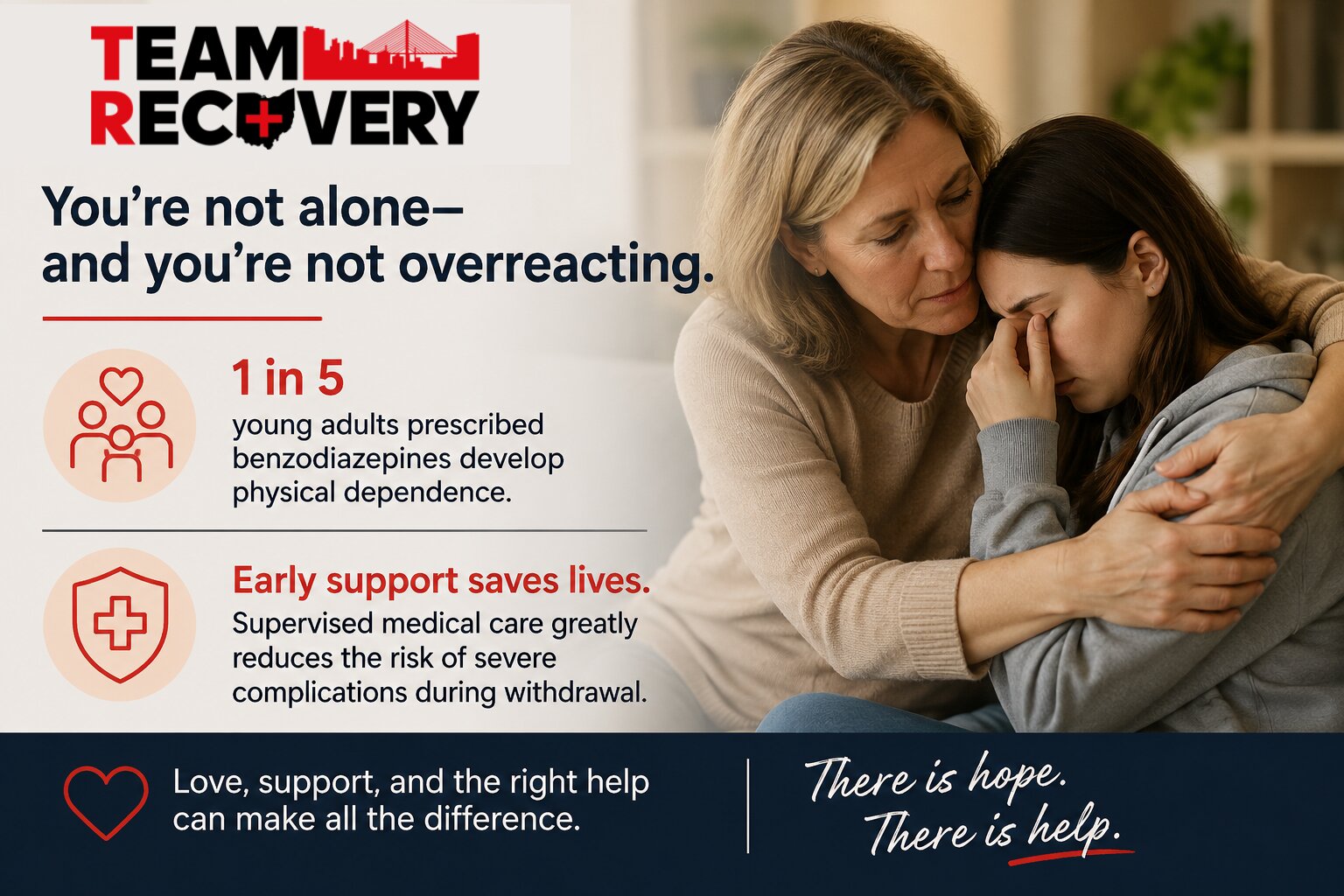
Why Parents Often Feel Guilty
Parents frequently carry guilt into situations like this.
They wonder:
“Should I have noticed sooner?”
“Did I miss something?”
“Could I have prevented this?”
These questions are understandable.
They’re also often unfair.
Many families are operating with limited information.
Benzodiazepine withdrawal can be confusing even for people experiencing it firsthand.
Trying to navigate it as a concerned parent is even harder.
If you’re reading this, it’s likely because you’re actively looking for ways to help.
That matters.
The fact that you’re seeking information right now says more about your commitment than any mistake you’re worried you made in the past.
What Does Helpful Support Actually Look Like?
Parents often feel pressure to say the perfect thing.
In reality, the most effective support is usually much simpler.
Helpful responses often include:
Ways to Support a Loved One
- Listening without arguing
- Staying calm during panic episodes
- Encouraging professional evaluation
- Helping coordinate appointments
- Offering transportation if needed
- Avoiding criticism or blame
- Providing reassurance without minimizing symptoms
A phrase like:
“I can see this is really hard right now.”
is often more helpful than:
“You need to calm down.”
Validation doesn’t mean agreeing with every fear.
It means recognizing that the suffering is real.
Stories We See More Often Than Families Realize
One reason families become overwhelmed is that they assume difficult withdrawal means permanent damage.
In most cases, that isn’t true.
We’ve worked with young adults who were convinced they would never feel normal again.
We’ve met parents who believed their child would remain trapped in panic forever.
Months later, many of those same families describe a completely different reality.
Their loved one is sleeping again.
They’re thinking clearly.
They’re rebuilding routines.
They’re reconnecting with life.
Recovery rarely happens overnight.
But improvement happens more often than fear would have you believe.
That’s important to remember during the hardest moments.
When Is It Time to Seek Immediate Help?
Certain symptoms warrant immediate medical attention.
Seek emergency care if someone experiences:
- Seizures
- Hallucinations
- Severe confusion
- Loss of consciousness
- Significant changes in awareness
- Dangerous physical symptoms
Trust your instincts.
If something feels seriously wrong, it’s worth getting evaluated.
It’s always better to ask for help and discover things are stable than to ignore a potentially dangerous situation.
Frequently Asked Questions
Can someone stop benzodiazepines safely on their own?
Some individuals attempt to stop independently, but abrupt discontinuation can carry risks. Medical guidance is generally recommended before making changes.
Why does anxiety seem worse than before the medication?
The nervous system may become temporarily overactive during withdrawal, causing anxiety to feel significantly more intense.
How long can withdrawal symptoms last?
The timeline varies considerably depending on the medication, dosage, duration of use, and individual health factors.
Can panic attacks occur during withdrawal?
Yes. Panic attacks are among the symptoms some people experience during withdrawal.
Are seizures really possible?
Yes. While not everyone develops seizures, they are a recognized risk associated with benzodiazepine withdrawal.
What if my child says they’re fine?
Some individuals underestimate symptoms or avoid discussing them. Continue observing changes and encourage open communication.
Is withdrawal the same thing as addiction?
Not necessarily. Physical dependence and addiction are related but different concepts. A healthcare professional can help assess an individual’s situation.
Can withdrawal affect sleep?
Absolutely. Difficulty sleeping is one of the most commonly reported experiences during withdrawal.
What if my child refuses professional help?
Keep communication open and avoid ultimatums whenever possible. Continue expressing concern while encouraging evaluation and support.
Do people recover from this?
Yes. Many individuals successfully navigate withdrawal and go on to live healthy, stable lives. Recovery may take time, but improvement is possible.
Should parents blame themselves?
No. Families often carry guilt, but withdrawal is a medical and neurological process. Focusing on support and next steps is usually more productive than looking backward.
What’s the most important thing a parent can do?
Stay connected. Listen carefully. Encourage professional support. Consistent presence can be incredibly meaningful during difficult periods.
If your son or daughter is struggling after stopping benzodiazepines, remember that today’s panic doesn’t necessarily predict tomorrow’s outcome. Many families have stood where you’re standing now and eventually watched their loved one regain stability, confidence, and hope.
Call 419-314-4909 or visit our Medical Detox Program to learn more about our Medical Detox Program services in Toledo, Ohio.

