





There’s a specific kind of exhaustion parents carry when their child returns to detox again.
Not loud exhaustion.
Quiet exhaustion.
The kind that sits in your chest while you wait for late-night phone calls. The kind that makes you afraid to feel hopeful because hope has hurt before. The kind that leaves you replaying every conversation in your mind wondering if you missed something important.
A lot of parents eventually ask the same painful question:
“How many times can someone go to detox before it actually works?”
Usually, what they really mean is:
“How many more times can my child survive this?”
“How many more times can our family survive this?”
“How do I keep believing recovery is possible when we’ve already tried so hard?”
If this is where you are, we want you to know something clearly:
A return to detox does not automatically mean your child is hopeless.
For many families exploring safe detox and stabilization support, one of the hardest realities to accept is that recovery often unfolds much more slowly—and much less cleanly—than anyone wishes it would.
“Why Didn’t It Work the First Time?”
This is usually the first question parents ask after relapse.
And honestly, it makes sense.
Families often imagine detox as the turning point where everything finally changes permanently. They expect the fear, pain, and consequences to finally “wake someone up.”
Sometimes that happens.
But addiction is rarely that simple.
Detox is designed to help stabilize the body safely while substances leave the system. It addresses immediate physical dependence and withdrawal risk. It creates a pause in the chaos.
But addiction itself is usually tied to much more than physical dependence alone.
Especially in younger adults.
Many people returning to substances are also struggling with:
- Anxiety
- Depression
- Trauma
- Emotional dysregulation
- Social pressure
- Isolation
- Shame
- Identity confusion
- Difficulty coping with stress
Sometimes when mental health and substance use collide, the urge to use substances again can overpower even sincere intentions to stay sober.
This is something parents often misunderstand painfully.
Your child may truly mean it every single time they say:
“I’m done.”
“I don’t want to live like this anymore.”
“I’m going to change.”
Addiction can still overpower that intention.
That does not erase accountability. But it does help explain why relapse happens even when someone genuinely wants relief.
“Is It Normal for Someone to Go Back More Than Once?”
Yes.
Much more common than most families realize.
Parents are often shocked by how nonlinear recovery can look in real life.
They picture a straight path:
Detox → Treatment → Recovery → Stability.
But addiction recovery often looks more like learning to walk again after an injury.
Progress.
Falling.
Regaining balance.
Losing balance again.
Trying anyway.
That does not mean relapse should be minimized or ignored. Substance use can absolutely become life-threatening. Families still need boundaries, safety plans, and support.
But repeated detox admissions do not automatically mean treatment “failed.”
Many people now living stable, meaningful, sober lives once returned to detox multiple times before recovery became more consistent.
That doesn’t erase the fear their families experienced.
But it matters because hopelessness can quietly become one of the most dangerous things addiction does to families.
“Why Does My Child Keep Asking for Help and Then Using Again?”
This question breaks parents apart emotionally.
Because from the outside, it can feel confusing or even manipulative.
But internally, addiction often creates a painful split inside a person:
One part desperately wants relief.
Another part is terrified to let go of the substance they rely on emotionally.
Young adults especially may still be learning:
- How to regulate emotions
- How to tolerate stress
- How to manage anxiety
- How to exist socially without substances
- How to cope with shame
- How to calm their nervous system
Substances often become more than recreation over time.
They become:
- Emotional escape
- Temporary relief
- Sleep aid
- Social confidence
- Anxiety management
- Numbing mechanism
That’s why many people relapse even after genuinely wanting sobriety.
One thing clinicians often tell families:
Your child is probably exhausted too.
Even if they don’t show it clearly.
Living inside addiction often feels like being trapped in a burning building while also being afraid to leave the fire.
“Can Alcohol Withdrawal Become Dangerous?”
Yes.
This is one reason repeated detox attempts deserve careful medical attention.
Many parents searching questions related to alcohol withdrawal at home are trying to figure out whether their child can safely stop drinking without professional support.
Sometimes families underestimate the danger because their child still appears functional between episodes of heavy drinking.
But alcohol withdrawal can become medically serious.
Symptoms may include:
- Severe shaking
- Sweating
- Vomiting
- Elevated blood pressure
- Panic
- Hallucinations
- Confusion
- Seizures
Not everyone experiences severe withdrawal, but unpredictability is part of the risk.
Repeated cycles of stopping and restarting alcohol use may also increase medical complications over time.
That’s one reason medically supported detox can matter so much—especially after multiple relapse cycles.
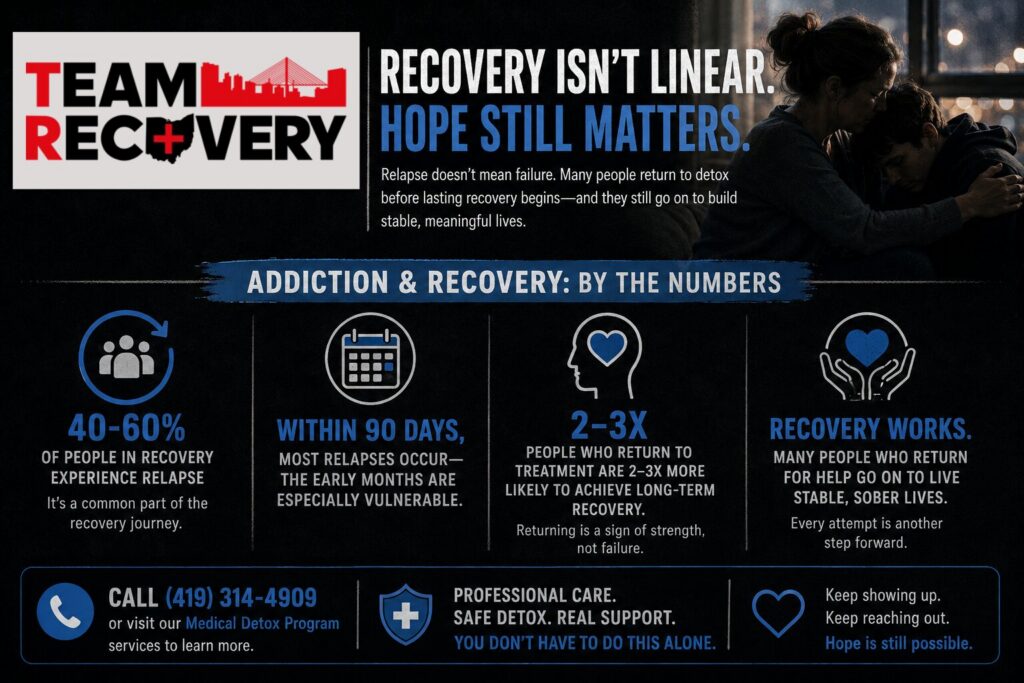
“How Many Times Is Too Many?”
Parents ask this question quietly because they’re terrified of the answer.
But recovery does not follow a universal timeline.
Some people stabilize after one detox stay.
Others need several treatment experiences before deeper recovery begins to hold consistently.
What matters more than counting attempts is looking at the bigger picture:
- Are they still alive?
- Are they still reaching for help sometimes?
- Are there moments of honesty?
- Are they reconnecting with support systems?
- Is there increasing awareness over time?
Progress is not always dramatic initially.
Sometimes the first detox simply interrupts immediate danger.
The second creates emotional insight.
The third reconnects someone to recovery community.
The fourth finally addresses underlying trauma or mental health issues.
Parents understandably want certainty:
“Tell me this time will work.”
But recovery rarely offers guarantees.
What it does offer is possibility.
And sometimes possibility is what keeps families going long enough to eventually see change happen.
“What If We’re Losing Hope?”
This is the part families rarely say out loud.
Because many parents feel guilty for becoming emotionally tired.
But loving someone through addiction can feel like living inside constant uncertainty.
Parents begin monitoring:
- Tone of voice
- Sleeping patterns
- Missing calls
- Bank activity
- Mood changes
- Late-night texts
- Every small behavioral shift
The nervous system of the entire family changes.
People stop relaxing fully.
Stop trusting peaceful moments.
Stop believing good periods will last.
That level of emotional hypervigilance is exhausting.
And honestly, some parents become so focused on saving their child that they disappear emotionally themselves.
You matter too.
That’s important to say clearly.
Your health matters.
Your sleep matters.
Your mental stability matters.
Supporting your child should not require destroying yourself completely.
“How Do We Support Without Enabling?”
This is one of the hardest balances families face.
Because love naturally wants to rescue.
But rescuing and supporting are not always the same thing.
Healthy support may include:
- Encouraging professional care
- Staying emotionally connected
- Setting financial boundaries
- Refusing to normalize dangerous behavior
- Seeking family therapy
- Learning about addiction
- Allowing natural consequences sometimes
- Protecting your own wellbeing
Parents often fear boundaries will make things worse.
But boundaries are not punishments.
They are attempts to create safety—for everyone involved.
“Does Detox Still Matter If Someone Relapses Again?”
Absolutely.
Even when relapse happens afterward, detox can still:
- Prevent medical emergencies
- Reduce withdrawal dangers
- Interrupt life-threatening spirals
- Reconnect someone to care
- Create moments of clarity
- Keep someone alive long enough for recovery to deepen later
That last part matters deeply.
Sometimes survival itself is progress during dangerous periods of addiction.
A young adult returning to detox again may not feel hopeful in the moment.
But it can still mean:
Part of them is still fighting.
Part of them still wants help.
Part of them has not fully given up.
That matters more than families often realize.
“What If My Child Doesn’t Seem Ready?”
Many people entering detox are not fully ready.
They’re scared.
Ambivalent.
Ashamed.
Emotionally exhausted.
Still attached to substances.
Still unsure who they are without them.
That does not make recovery impossible.
Most people entering treatment are not walking in full of confidence and certainty.
They’re walking in overwhelmed.
Sometimes readiness grows slowly after support begins—not before.
FAQ: Questions Parents Commonly Ask About Repeat Detox Admissions
Is it common for someone to go to detox more than once?
Yes. Many people require multiple detox or treatment experiences before long-term recovery becomes stable. Relapse is common in substance use disorders.
Does relapse mean detox failed?
Not necessarily. Detox helps stabilize the body safely, but recovery often involves ongoing emotional, psychological, and behavioral healing afterward.
Why does my child keep relapsing after promising to stop?
Many people genuinely want recovery while still struggling with cravings, mental health symptoms, emotional pain, or fear of sobriety itself.
Can alcohol withdrawal become dangerous?
Yes. Withdrawal can involve serious symptoms, including seizures or hallucinations in some cases. This is why many families worry about alcohol withdrawal at home and seek medical support.
Should we stop helping if relapse keeps happening?
Support and enabling are different. Families can remain compassionate while still maintaining healthy boundaries around safety, money, housing, and accountability.
Why do young adults struggle so much with relapse?
Young adults are often still developing emotional coping skills, identity, and mental health stability while also battling addiction.
Can someone recover after multiple detox stays?
Absolutely. Many people in stable recovery today once returned to detox or treatment several times before recovery became more consistent.
What if our family feels emotionally exhausted?
That feeling is extremely common. Addiction affects entire families. Parents often benefit from therapy, support groups, education, and emotional support too.
How do we know if progress is happening?
Look for patterns over time: honesty, accountability, willingness to reconnect with support, emotional awareness, and increased openness to treatment can all signal growth.
If your child has returned to detox more than once, it does not automatically mean hope is gone.
Sometimes recovery looks less like a straight line and more like someone slowly finding their way back through heavy fog.
And sometimes the fact that they came back at all means part of them still believes life could become different.
Call (419) 314-4909 or visit our Medical Detox Program services to learn more about our Medical Detox Program services Toledo, Ohio.

