





There’s a moment before you ask for help where everything gets very quiet.
Not peaceful—just still. Like your life has paused, and you’re standing at the edge of something you can’t fully see yet.
If you’re here, considering something like detox support, it probably means you already know something needs to change. You may not feel ready. You may not feel sure.
That’s okay.
You don’t need certainty to take a first step. You just need a small opening—a moment where you admit this isn’t working anymore.
Let’s talk about what this actually feels like, not the version your anxiety is creating.
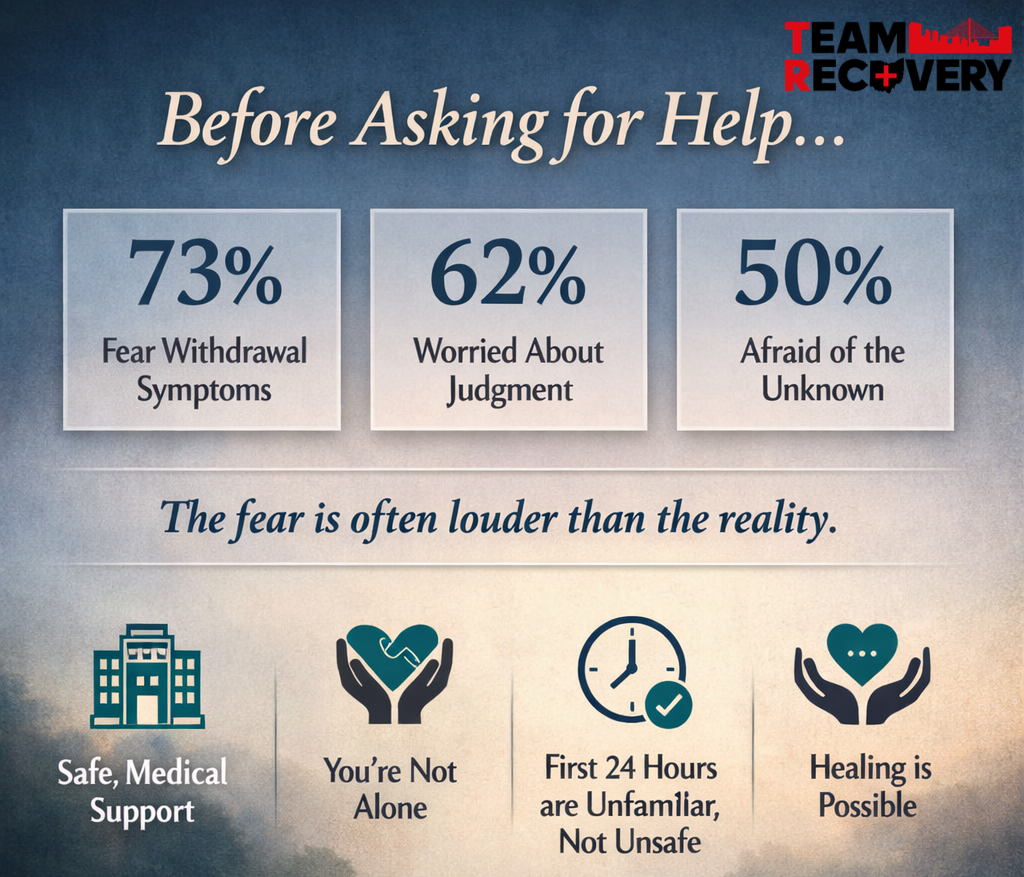
The fear before you arrive is usually louder than the reality
Before someone walks through the door, their mind fills in the blanks.
People imagine worst-case scenarios:
- “What if it’s unbearable?”
- “What if I panic and can’t leave?”
- “What if I’m judged?”
That fear can feel so real it almost stops people from coming in.
But once they arrive, something unexpected tends to happen.
The intensity drops—not completely, but enough.
Because now there’s structure. There are people. There’s a plan.
One patient said it best:
“It wasn’t that I suddenly felt okay. It’s that I didn’t feel alone in it anymore.”
And that changes everything.
The first 24 hours feel unfamiliar—but not unsafe
Let’s be honest—this part can feel uncomfortable.
Your body is adjusting. Your system is reacting. You might feel off in ways that are hard to describe.
Common experiences in those first hours:
- Restlessness or fatigue
- Anxiety that comes in waves
- Difficulty sleeping
- Physical discomfort that shifts over time
But here’s what matters:
You’re not guessing your way through it.
There are people monitoring what’s happening. Making adjustments. Helping your body through it step by step.
You’re not expected to manage this alone.
And that sense of being held—even quietly—makes the discomfort feel more manageable.
You don’t have to be “ready” for this to work
This is one of the biggest misconceptions.
People think they need to show up fully committed, fully motivated, completely sure.
You don’t.
You can walk in feeling:
- Unsure
- Skeptical
- Scared
- Even resistant
We expect that.
Because this isn’t about proving something—it’s about starting something.
Your readiness doesn’t have to be perfect. It just has to exist, even in a small way.
Your body starts to settle before your mind catches up
This part can feel confusing.
Mentally, you might still be questioning everything:
- “Do I really need this?”
- “Maybe I could’ve handled it on my own”
- “What if I leave?”
Meanwhile, your body is doing something different.
It’s stabilizing.
Slowly, quietly:
- Sleep starts to return in fragments
- Your system becomes less reactive
- The intensity of symptoms begins to shift
It’s not instant. It’s not dramatic.
But it’s happening.
And often, your body believes in the process before your thoughts do.
Time feels different here—and that’s a good thing
Outside of this environment, time can feel chaotic.
Everything is rushed. Decisions pile up. Emotions hit all at once.
Inside, things slow down.
Not in a boring way—but in a manageable way.
You’re not juggling everything at once.
You’re not trying to fix your whole life in a day.
You’re just moving through hours.
And sometimes, that’s the first time in a long time your nervous system gets a break.
You’re allowed to focus on just getting through today
One of the biggest fears people have is:
“What happens after this?”
It’s a fair question. But it’s also one that can overwhelm you too early.
You don’t have to decide everything right now.
Right now, the goal is simple:
Get through this phase safely.
That’s it.
Decisions about next steps—whether that’s structured daytime care, multi-day weekly treatment, or another level of support—can come later, when your body and mind are more stable.
Clarity tends to follow stability. Not the other way around.
You won’t be as alone in this as you think
Many people expect isolation.
But what they find instead is something quieter—and more powerful.
You’re around people who understand without needing long explanations.
No one expects you to have the right words.
No one expects you to minimize what you’re feeling.
Even small moments—eye contact, a short conversation, sitting in the same space—can remind you:
You’re not the only one going through this.
And that matters more than most people realize.
The hardest step is often the one before you arrive
There’s a mental loop that happens before treatment.
It sounds like:
- “I’ll go tomorrow.”
- “Maybe it’s not that bad.”
- “I just need to get through today.”
That loop can last weeks, months, sometimes longer.
Breaking that loop—making the call, showing up—that’s often the hardest part.
Because once you’re in, the decision is already made.
You’re no longer stuck in the question.
You’re in the process.
A moment most people remember later
There’s often a small moment—nothing dramatic—where something shifts.
It might be:
- The first time you sleep a little better
- The first time your body feels even slightly calmer
- The first moment you realize, “Okay… maybe I can do this”
It doesn’t come with fireworks.
But it stays with people.
Because it’s the first real sign that change is possible—not just in theory, but in your body, in real time.
A quiet truth about starting
You don’t need to feel strong to begin.
You don’t need to have it all figured out.
You just need one honest moment where you admit:
“I can’t keep going like this.”
That moment is enough.
Everything else can come later.
FAQs About Taking This First Step
Will it be painful?
There can be discomfort, yes. But the goal is to make it manageable—not overwhelming. You’re supported through each phase so you’re not facing it alone or without care.
How long does this stage last?
It varies depending on your body, your history, and what substances are involved. Some people stabilize in a few days, others take longer. The focus isn’t speed—it’s safety and stability.
What if I panic or want to leave?
That’s more common than people expect. Those feelings usually come in waves. Having support in those moments makes a big difference—and most people are able to move through them.
Will I be judged for how I got here?
No. Truly. We’ve seen a wide range of experiences, and the focus is never on judging—it’s on helping you stabilize and move forward.
Do I have to commit to more treatment after this?
No immediate decisions are required. You’ll have space to understand your options once you’re feeling more clear and stable.
What should I bring with me?
You don’t need to overthink it. Basic essentials and comfortable items are enough. The most important thing you’re bringing is yourself—even if you’re unsure.
What if I’m not “bad enough” to need this?
This is one of the most common thoughts. If you’re questioning whether you need help, that’s already worth paying attention to. You don’t have to hit a certain level of struggle to deserve support.
There’s a version of you on the other side of this phase that feels steadier.
Not perfect. Not finished.
But more grounded. More clear. More like yourself.
And sometimes, that’s the first real step back to everything you thought you lost.
Call 419-314-4909 or visit our detox support to learn more about our Medical Detox Program services in Toledo, Ohio.

