





You’ve got the job. The mortgage. Maybe even the spouse, the kids, the calendar full of meetings. From the outside, everything’s fine.
But inside?
You’re running on fumes—and no one knows but you.
Because you still show up. You still smile. You still answer emails and hit your deadlines and make small talk at the office. But lately, the cracks are harder to hide. The hangovers are heavier. The guilt is louder. And the moments of silence feel suffocating.
You keep telling yourself: This is just a rough patch. It’ll pass.
But what if it’s not just stress? What if it’s not just “overdoing it”?
What if this is the point where you stop pretending you’re okay—and start asking what your life could look like if you didn’t have to manage this all alone?
Let’s be clear: live-in treatment isn’t just for people who’ve “lost everything.” Sometimes, it’s for people who have too much on the line to keep spiraling in silence.
The Lie High-Functioning People Tell Themselves
“I’m not that bad.”
It’s the most common—and most dangerous—sentence we hear from high-performing clients.
Because on paper, you’re winning. You’re still functioning. Maybe even thriving in some areas. You haven’t crashed your car. You haven’t lost your job. You haven’t been caught.
But here’s the thing:
If “functioning” means surviving on coffee and substances, feeling numb or angry most of the time, and hiding parts of yourself from everyone you love—then what exactly are you protecting?
Not that bad doesn’t mean good.
Still standing doesn’t mean well.
Getting through the day isn’t the same as living.
You’re Not Weak—You’re Worn Out
Addiction doesn’t always look like chaos. Sometimes it looks like order—polished and successful on the outside, unraveling quietly underneath.
Maybe it started as a way to take the edge off—wine after work, a few pills to sleep, just enough to keep going. But now the edge never really goes away. Now it feels like you’re managing yourself more than living your life.
Here’s what I’ll tell you as a clinician:
High-functioning addiction is still addiction.
And carrying it alone doesn’t make you strong. It makes you tired.
If the idea of stopping scares you more than the reality of continuing—pay attention. That’s a signal worth listening to.
But I Can’t Step Away… Can I?
You’ve worked too hard to blow it all up now, right?
That’s the trap. The fear that if you slow down, everything you’ve built will collapse. The truth is, most high-functioning individuals wait until just before collapse to ask for help—and by then, the damage is harder to undo.
What you don’t see right now is what it’s already costing you:
- Your peace
- Your presence with loved ones
- Your capacity for joy
- Your actual health
Round-the-clock care isn’t a punishment—it’s a reset. A break from survival mode. A way to interrupt the burnout before it becomes destruction.
You don’t have to vanish forever. Most programs are built with flexible, medically informed structures that support your life—not erase it.
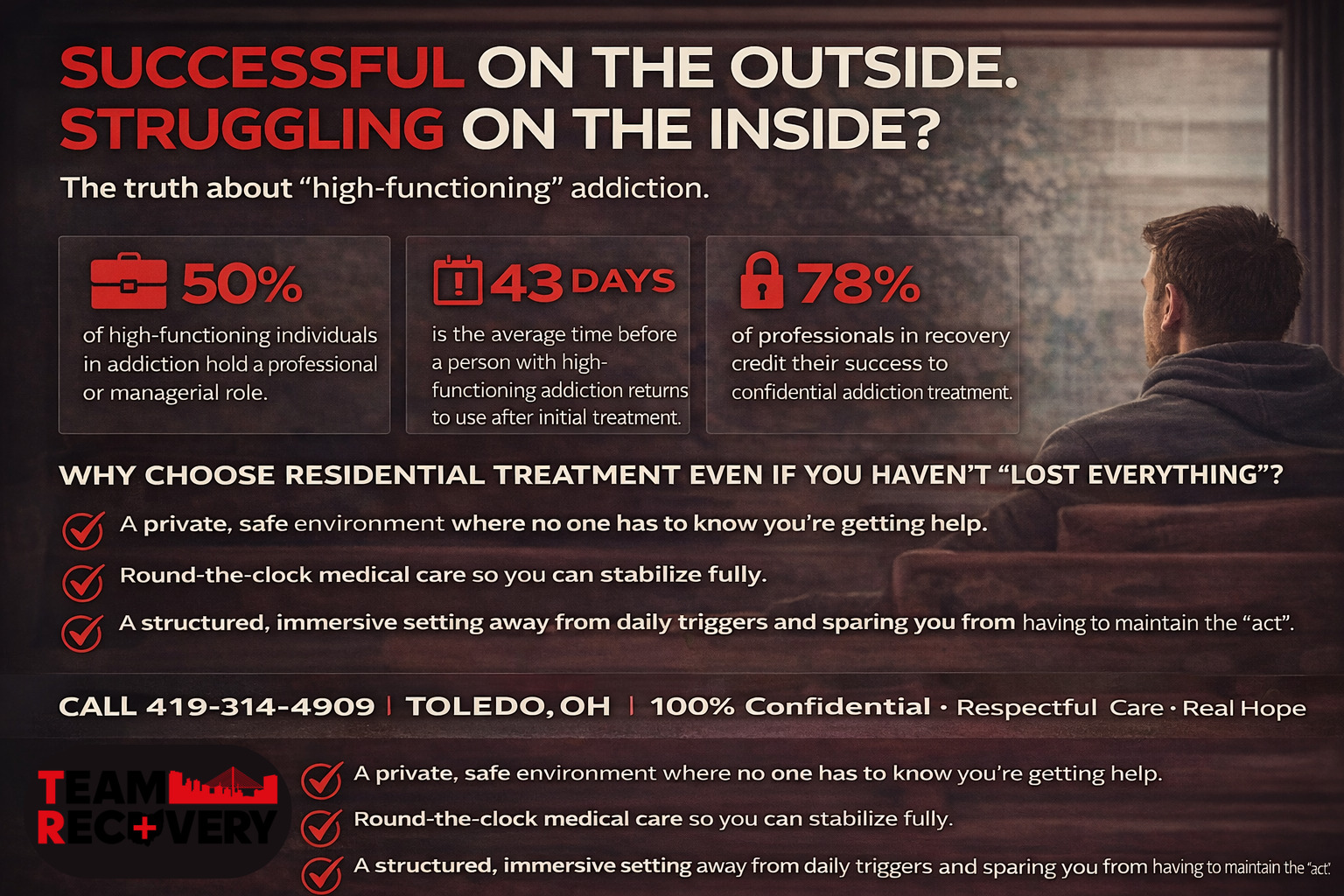
What “Help” Actually Looks Like
Let me clear something up: Seeking treatment doesn’t mean checking into a place where you lose your identity, your autonomy, or your dignity.
At Team Recovery, we specialize in supporting people who are still holding it together on the outside—but unraveling on the inside. That means:
- Private, respectful care—no group shaming or labels
- Clinical assessments that meet you where you are
- Staff who’ve worked with attorneys, executives, medical professionals, and parents alike
- A treatment plan tailored to your reality—not someone else’s rock bottom
This is real work. But it’s also relief. And most clients tell us the same thing once they start:
“I didn’t realize how much I was carrying—until I finally put it down.”
You’re Allowed to Want More Than Coping
Maybe you’ve gotten so used to managing your pain, you forgot what it feels like to imagine something better.
That’s common for high-functioning people. You learn how to push through, numb the noise, outwork the shame. But what if you didn’t have to?
What if you could have:
- Mornings without regret
- Sleep that’s actually restful
- Relationships built on honesty, not performance
- A life that doesn’t rely on secret scaffolding to stay upright
Recovery doesn’t strip away your success—it helps you redefine it on your terms.
Let’s Get Rid of the “I’m Not That Kind of Person” Excuse
High-functioning clients often delay care because they think residential treatment is for someone else—someone “worse off,” someone “out of control,” someone who doesn’t have anything to lose.
But we’ve worked with:
- Lawyers
- Surgeons
- Entrepreneurs
- Stay-at-home parents
- College students
- Blue-collar workers pulling overtime
What they all had in common?
They didn’t wait for a perfect time. They chose to get honest.
FAQ: High-Functioning and Considering Residential Care
Do I really need a residential program if I’m still functioning?
If you’re asking the question, something isn’t working. “Functioning” doesn’t mean you’re well—it just means you’re coping. If substances are becoming a necessary part of how you get through the day or manage emotions, it’s time to explore support.
Will I lose my job if I go to treatment?
Many clients use FMLA (Family and Medical Leave Act) protections, and we can help guide you through that process. We’ve supported clients in navigating leave without disclosing more than necessary. You don’t have to go it alone—or risk everything to get help.
What if I don’t want to be labeled an “addict”?
Labels aren’t required for healing. Our focus is on what’s working and what’s not—without shame. If you’re using something to cope and it’s hurting you, we can help. You don’t have to accept a label to deserve support.
Is the program confidential?
Yes. Our programs are 100% confidential. We understand the unique privacy concerns of professionals, parents, and public-facing individuals. Protecting your dignity is non-negotiable.
I’m scared to stop. Is that normal?
Yes. Fear is natural—especially when substances have become your coping tool. You don’t have to be fearless to start. You just have to be willing to let someone walk with you through the next step.
Ready to Talk?
If you’ve read this far, something in you knows it’s time. You don’t need to crash to deserve care. And you’re not “too successful” to stop pretending you’re fine.
Call 419-314-4909 or explore our residential treatment program services to learn how we help high-functioning individuals find real recovery, real rest, and real freedom.
Your success doesn’t have to come at the cost of your soul. You’ve carried enough. Let’s talk about setting it down.

